

The history of whiskey begins, true to its name, with the “water of life,” a spirit born in the monasteries and hills of Ireland and Scotland and first written about in 1405. From there, smugglers hiding spirit in oak casks gave it amber color and depth, the column still created smooth blended Scotch, distillers carried it west to become bourbon, Prohibition lifted Canadian whisky, and two pioneers brought it to Japan.
Pour a dram tonight and taste six centuries of history in a single glass.
The Birthplace of Whiskey
Distilling grew out of the work of ancient alchemists, whose techniques were refined over centuries. By around the 12th century, distilled spirits had appeared in Europe, often valued as medicine.
Exactly where whiskey was born is still unknown. Two leading theories point to Ireland and Scotland, both famous whiskey nations, though neither has decisive proof.
The Irish Theory

Photo | King Henry II of England | Image source: Wikipedia
According to legend, when King Henry II of England invaded Ireland in 1171–72, his soldiers found locals drinking a spirit called “uisce beatha.” There’s no clear evidence for this story, so it remains a tradition.
Still, Ireland holds an early written clue. The Annals of Clonmacnoise record that in 1405, a chieftain named Richard Magranell died at Christmas after drinking too much aqua vitae. Because this is widely cited as the earliest written mention of whiskey, many consider Ireland the slightly stronger candidate.
The Scottish Theory

In 1494, Scotland’s Exchequer Rolls recorded an order granting eight bolls of malt to Friar John Cor “wherewith to make aqua vitae.” It’s the oldest written record of whiskey-making in Scotland, and the mention of malt shows it was made from barley.
“Uisce beatha” eventually became the word “whiskey.” “Aqua vitae,” Latin for “water of life,” was used for many spirits, including brandy, which is why it refers to distilled spirits in general.
Ireland may hold a slight edge, but there’s no doubt these two nations created whiskey and shaped its growth.
The Whiskey Smuggling Era

For a long time after whiskey was born, it wasn’t aged in barrels as it is today. Freshly distilled whiskey was clear and colorless, and people drank it just as it came from the still.
Barrel aging became common from around the 18th century, and one of the most popular stories links it to smuggling. From the 17th to the 19th century, Scotch whisky was heavily taxed, so many producers hid deep in the Highland mountains to make it in secret.
To hide their spirit, they stored it in wooden casks. Over time, the clear liquid turned amber and became richer, more aromatic and smoother, because the wood slowly shaped its flavor.
Moonshining taught producers more than barrel aging. They also learned that pure mountain water and cool, crisp air were ideal for making and storing whisky.
In 1822, King George IV visited Scotland and is said to have asked for illicit Glenlivet whisky. This was only one factor, but in 1823 the Excise Act was reformed, and in 1824 the Glenlivet distillery became one of the first to be licensed under the new law.
Other illicit distillers gradually followed and took out licenses. Detections of illegal stills fell from around 14,000 a year in the early 1820s to just a few hundred within about a decade, and the smuggling era came to an end.
The Rise of Scotch Whisky

In 1707, Scotland and England united to form the Kingdom of Great Britain. Yet the old rivalry didn’t fade overnight, and many English drinkers saw Scotch whisky as little more than a rough country spirit.
Two key events turned that humble spirit into a drink enjoyed across Europe.
1. The Arrival of the Column Still

Photo | Coffey still | Image source: Wikipedia
In 1830, Aeneas Coffey, an excise officer in Ireland who had run Dublin’s Dock Distillery, patented his continuous column still. Fittingly, this invention born in Ireland made it possible to produce large amounts of affordable grain spirit.
At the time, Scotch was mainly bold malt whisky made only from malted barley, which the huge London market found too strong. The column still made lighter grain whisky from corn and other grains possible, and blending malt with grain created a smooth, refined style that everyone could enjoy.
In 1860, a new law allowed whiskies from different distilleries to be blended under bond. With cheap, plentiful grain whisky now in high demand, blended Scotch quickly gained attention.
2. The Phylloxera Crisis

Photo | Phylloxera (Daktulosphaira vitifoliae), the grape phylloxera
Even with the column still, Scotch whisky couldn’t yet match the popularity of wine and brandy in London. Then, from the 1860s, disaster struck Europe’s vineyards: an outbreak of phylloxera, a tiny vine-killing insect.
Phylloxera feeds on the roots of grapevines, slowly sapping their strength until they die. Because it lives underground, sprays were useless, and it took around 30 years to find a solution, grafting vines onto resistant American rootstock.
As wine and brandy grew scarce, London gentlemen turned to Scotch whisky instead. Already smoother thanks to the column still, Scotch soon spread across Europe.
Irish whiskey, however, didn’t grow as quickly, partly because many Irish distillers chose not to adopt the column still. It’s a touch of irony, since that very still was born in Ireland.
America and Whiskey
The Whiskey Rebellion and the Birth of Bourbon
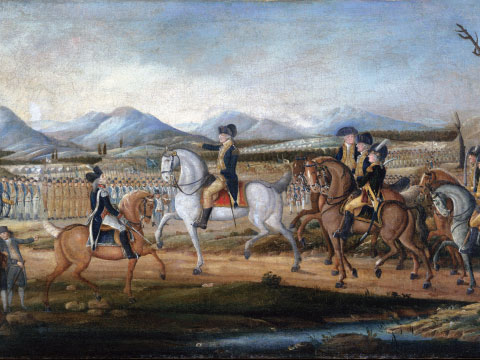
Photo | George Washington reviewing troops sent to suppress the Whiskey Rebellion
In the 18th century, many Scots who had first settled in Ireland, often called the Scots-Irish, crossed the Atlantic and made their homes around Pennsylvania. Alongside farming, they distilled spirits from rye and other grains, bringing their whiskey-making skills to the New World.
In 1775, the American Revolutionary War broke out between Britain and its Thirteen Colonies. The colonies won, and the war formally ended in 1783.
The new American government urgently needed to repair its finances. In 1791, it introduced a federal excise tax on domestically distilled spirits, which soon became known as the “whiskey tax.”
Much of that whiskey was made in poorer western Pennsylvania and sold to the wealthier east. Coins were scarce on the frontier, so whiskey was even used in place of money for trade.
For western farmers, whiskey was a vital source of income, and the tax deepened their long-standing sense of unfairness toward the east. Resistance grew fierce.
In 1794, when a U.S. marshal arrived to serve writs on those refusing to pay, the protests exploded. Around 500 armed men attacked the home of a federal tax inspector.
President George Washington decided to restore order by force. He gathered about 13,000 militiamen from several states and personally led them toward western Pennsylvania. The rebels scattered before the army arrived, so no major battle took place.
Many distillers then moved farther west to Kentucky and Tennessee, where corn grew in abundance. Fittingly, whiskey made from this local corn developed into a new American spirit: bourbon.
Prohibition and the Rise of Canadian Whisky
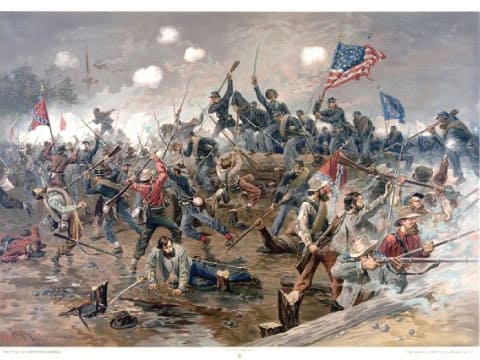
Photo | Battle of Spotsylvania, American Civil War
Abraham Lincoln was elected president in 1860. Deep divisions over slavery and trade policy split the North and the South, leading to the American Civil War.
The war lasted from 1861 to 1865 and ended in victory for the Union. Its toll was enormous, with an estimated 620,000 to 750,000 soldiers killed.
After the war, the whiskey industry moved forward quickly. American whiskey grew into large, modern businesses, and by the start of the 20th century it had entered a golden age.

Just as it seemed the growth would continue, Prohibition began in 1920. Under this law, often called one of the most misguided of the century, most American distilleries were forced to close, and the whiskey industry entered its dark age.
With American whiskey production at a standstill, attention turned north to Canada. After American independence, many colonists who had stayed loyal to Britain moved across the border, settling in areas around the Great Lakes, and distilling flourished there over the following century.
Producing whisky for export remained legal in Canada. Bootleggers and gangsters of the era, including the infamous Al Capone, smuggled it into the U.S., and Canadian whisky’s reputation rose sharply as a result.
The Beginning of Japanese Whisky
Whiskey’s First Arrival in Japan

Photo | Commodore Perry’s landing at Yokohama (1854), lithograph by Wilhelm Heine
In 1853, Commodore Matthew Perry’s U.S. Navy squadron sailed into Uraga, in today’s Kanagawa Prefecture, an event remembered in Japan as the arrival of the “Black Ships.” Perry brought many things Japan had never seen, and whiskey was among them, served to Japanese interpreters and officials.
Records show that a barrel of American whiskey was among the gifts presented to the shogunate. After the Treaty of Amity and Commerce was signed in 1858, ports such as Yokohama and Nagasaki opened in 1859, and whiskey imports slowly began.
The Two Men Who Laid the Foundation of Japanese Whisky

Photo | Masataka Taketsuru, founder of Nikka Whisky, and his wife, Rita
As Western culture became part of everyday life in Japan, more people began drinking Western spirits. Genuine whiskey was imported, but cheap imitations, made by adding sugar and flavorings to neutral spirits, soon spread as well.
After the Anglo-Japanese Alliance was signed in 1902, imports of Scotch whisky grew, and Japanese drinkers’ palates became more refined. Then, when Japan fully regained control of its tariffs in 1911, the price of imported whiskey rose.
Demand for real whiskey kept growing even as it became harder to afford. That gap inspired two men to make authentic whisky in Japan.
The first was Shinjiro Torii, who founded Torii Shoten in Osaka in 1899, the company known today as Suntory. His motto, “Yatte minahare,” meaning “Go for it,” still lives on as the company’s guiding spirit.
Torii built Japan’s first malt whisky distillery, Yamazaki, in 1923 and invited Masataka Taketsuru, who had studied whisky-making in Scotland, to lead production. Taketsuru later founded Nikka Whisky, and together their work set Japanese whisky on the path to becoming one of the world’s five great whisky styles.
Summary | The History of Whiskey at a Glance

True to its name, whiskey began as the “water of life,” born in Ireland and Scotland, with the earliest written records dating to 1405 and 1494. During the smuggling era, hiding spirit in wooden casks helped popularize barrel aging, giving whiskey its amber color and smooth flavor.
In the 19th century, the column still made blended Scotch possible, and the phylloxera crisis turned London drinkers from brandy to whisky. In America, the Whiskey Rebellion pushed distillers toward Kentucky, where bourbon was born, while Prohibition helped Canadian whisky rise to fame.
Finally, Shinjiro Torii and Masataka Taketsuru launched Japanese whisky with the Yamazaki distillery in 1923, completing today’s five great whisky styles: Irish, Scotch, American, Canadian and Japanese. Knowing this story adds a little extra depth to every glass you pour tonight.


